
Rodent Control
Learn more
Active nests near doors, decks, and play areas are a safety risk — our team removes wasps and hornets with the right gear and timing.
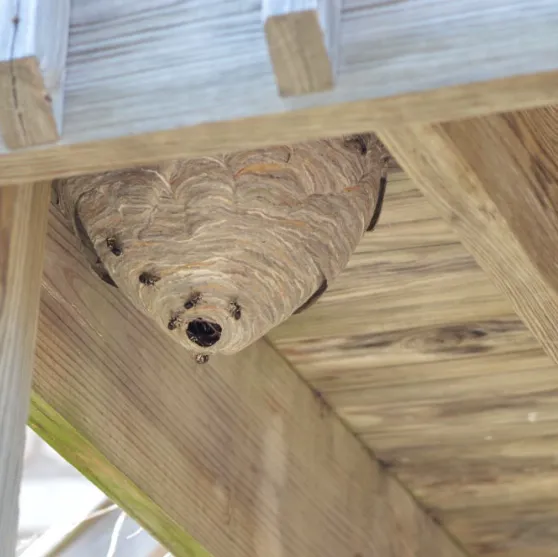
Stinging insects are our busiest summer call across Fredericton and Saint John, and the one where response time actually matters. A nest over a back door is not a nuisance — it is a hazard for anyone allergic, and for children and pets who will not see it coming.
Call rather than climbing a ladder if the nest is:
Yellow jackets nest in the ground, in wall voids and under decks, and they are the aggressive ones — they defend the nest hard and can sting repeatedly. Bald-faced hornets build the grey paper footballs you see hanging in trees and under eaves. Paper wasps build the smaller open-comb nests under railings, in barbecues and inside light fixtures. Late summer is the worst of it: the colony is at its largest and the workers are increasingly aggressive as the season turns.
One-time removals carry a written service guarantee for the season.
The customers who stop calling us in a panic every August are the ones who book the preventive exterior treatment in late spring. It targets the eaves, railings, soffits and door frames where queens start nests, before there is a colony to deal with. It is cheaper than multiple emergency removals and it means the deck is usable all summer.
5 out of 5 stars
“Came same day I called about my wasp nest which was under my pool deck in a tight area. He suited up in protective gear and crawled under with the spray. Don’t see any more wasps and I’m so happy to be able to access my pool again without worrying about getting swarmed.”
5 out of 5 stars
“Called Saturday morning on a long weekend. One hour later, my hornet problem was taken care of. Thanks!”
5 out of 5 stars
“I discovered a yellow jacket wasp nest in my crawlspace, about the size of a volleyball. Called Bob and he had Connor drop by the next day to tackle the wasp nest and dust a bees nest we discovered in-ground near my back door at the same time. By next morning all pest activity had ceased.”
Through the summer we treat most nests the same day or the next day, because a nest beside a door or over a walkway is a safety problem rather than an inconvenience. Customers regularly tell us we arrived within a couple of hours of the call, including on weekends during the peak of the season.
A small, exposed nest early in the season is sometimes a do-it-yourself job, and we will tell you honestly when that is the case. What goes wrong is nests inside a wall, in a crawlspace, under a deck or high on a roofline, where you cannot see the whole structure, cannot retreat quickly, and stirring up the colony puts you in the middle of it.
Wasps and hornets have smooth bodies, build paper nests and can sting repeatedly. Honeybees are fuzzy, live in a permanent colony and are pollinators worth protecting — if the nest is honeybees we will tell you, since relocation is the better answer there.
A treated nest is not reused, but the location that attracted one colony will attract another, because it offers the same shelter. That is why we treat the nest and then talk about the spot itself, and why the spring preventive spray is popular with customers who have had the same eave or deck used two years running.
Late spring, before queens establish their nests. Customers who book the treatment in May regularly tell us the property stayed clear for the whole summer, which is a much easier season than removing three nests in August.
Learn more
Learn more
Learn more
Learn more